
Pricing & tagging your items
Pricing is everything in the consignment world, and a securely attached tag is what turns your item into a check. Here's everything you need to price like a pro and tag like a champ.
💰 Price it to sell
Finding the sweet spot between pricing your items to sell and selling them to be profitable can be tricky! But here's the deal: pricing is everything in the consignment sale world, and you'll want to be on your A-game. Great pricing is often the difference between a 90% sell-through and picking up a huge stack of items at the sale's end.
On average, most items that sell at DDG fall between $3.50 and $7.50. Boutique items sell for higher prices, there are a lot of boutique-loving mamas in Central Arkansas, and the sweet spot for boutique pricing is somewhere between $8.50 and $15. Your goal is to turn clothing into dollars: price it to sell!
🤔 Two questions to ask yourself
- What would I be willing to pay for this item?
- Am I pricing too high because I have "emotional taggage" and a personal attachment to this item?
🏷 How do I determine my selling price?
In general, ask yourself "how much would I pay for this item?" You can also take the retail price and subtract 75% to get to a good selling price. Each brand has a different suggested range, so we've compiled a handy guide of brands and price ranges to help.
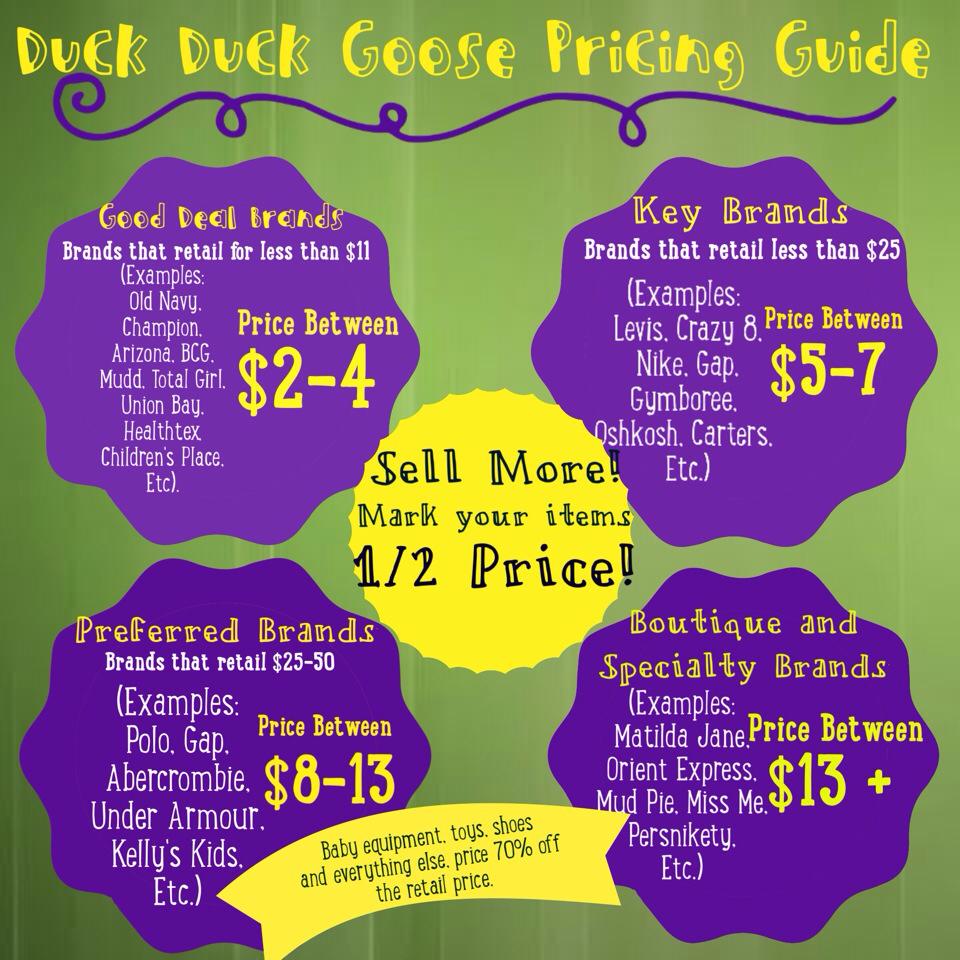
3 simple ways to be a pricing rock star
Make it look great
Hang items securely and neatly. Check carefully for stains and iron as needed. Button the buttons, zip the zippers, and trim loose threads. (You've heard this before, right? There's a reason, it works!)
Leave emotions out of it
It's easy to get wrapped up in memories while tagging baby clothes. That's normal, just don't let those memories affect your prices.
Tag securely, describe well
If a tag is lost, the description is the best way to match it back to the item, and DDG won't sell an item without its tag. Great descriptions are your best tagging tool!
🎉 How does the half-price sale work?
Each of our sales has specific times when your items have the opportunity to sell for half the original price. As you enter items into our pricing system, we'll ask whether you want to allow each item to go half price. If you do, that item is eligible to sell at half price during the designated half-price period. Items not designated half price can still sell at the full tag price.
Letting your items go half price is highly encouraged! You've spent time hanging and pricing, and your home is neater and cleaner because of your efforts, do you really want to bring a bunch of items back? Moms are always delighted to come back on check pickup day with only a few items to take home, and you'll love watching your sales amount grow at the end of the week. You're in complete control of which items go half price.
⚫ How can I tell if an item is marked half price?
You decide whether each item can sell at half price. If an item is designated to not go half price, a black dot appears on the tag. An easy way to remember: DOT = NOT.
💝 What does it mean to donate my items?
Duck Duck Goose has partnered with local charities to receive any items that don't sell and are marked "Donate" by the consignor. Additionally, any items not picked up by the end of the pick-up period are donated to charity.
🖨 How do I make price tags?
Our online tagging system generates the tags for you! Just log in to your consignor account and enter your items, the tagging how-to below walks you through the rest.
Now, let's tag! Here's how it works
Organize items
Sort your items in a way that makes sense to you, it makes computer entry much quicker.
Enter items
Each item gets a unique barcode. That barcode makes sure you get credit when your item sells.
Print barcodes
Print your tags on cardstock and cut them apart.
Attach tags
Attach each tag to its matching item, securely!
🗂 Preparing for item entry
Organizing your items ahead of time helps entry go faster. Any system works, one suggestion is to enter all girls' clothes, then boys' clothes, girls' shoes, boys' shoes, toys, baby equipment, and finally furniture. It's completely up to you, but organization really helps!
🏷 Choosing a tag type
Every item must be tagged with an individual, unique barcode. There are two tag options, so pick the one that works best for you:
- Detailed tags (most popular, recommended): You enter details about each item - description, size, brand, color, and so on. You can track each item individually, and when a detailed-tag item sells, you can see exactly which items sold.
- Express tags: A quick way to tag, but with some manual work, you hand-write the description on each tag. We can give you a summary of your sold items, but we can't show you online which specific items sold.
The choice is completely yours, but we highly recommend detailed tags.
⌨️ Entering your tags
Log in to your consignor account, choose "My Items" from the menu, and then choose "Add Items". You'll be prompted to pick the type of tag you'd like to create.
For detailed tags, you'll enter information for each item. You aren't required to fill in every field, although description and price are required.
For express tags, you'll simply decide how many tags you need and the price for each - for example, 5 tags at $5.50.
🎤 Voice tag entry
When you visit our website from a mobile device, our system can use your phone or tablet's microphone to understand what you say and turn it into a tag. Not sure what the microphone button looks like? Here's an example for iPhone/iPad and Android.
The system listens for several key words so it knows where to put each piece of information: BRAND, COLOR, PATTERN, SIZE, PRICE, DONATE, and HALF PRICE. What you say after each key word fills in that field. For example:
- Sun dress BRAND babyGap COLOR green PATTERN polka dot SIZE 3T PRICE three dollars and fifty cents DONATE yes HALF PRICE no
- Boy polo PRICE four dollars
- Girl shoes PRICE eight dollars and twenty five cents DONATE yes
A few things to remember:
- Your description should always go first, followed by the other key words.
- You must say all the words for the price, for example, "eight dollars and twenty five cents".
- We can even correct some common typing hiccups, if your phone types "genes", we'll convert it to "jeans" for you.
🖨 Printing tags
It is absolutely critical to print your tags on white cardstock. Colored cardstock can be hard to read and doesn't scan as easily during checkout. Once printed, use scissors to cut each tag apart along the lines on the printout.
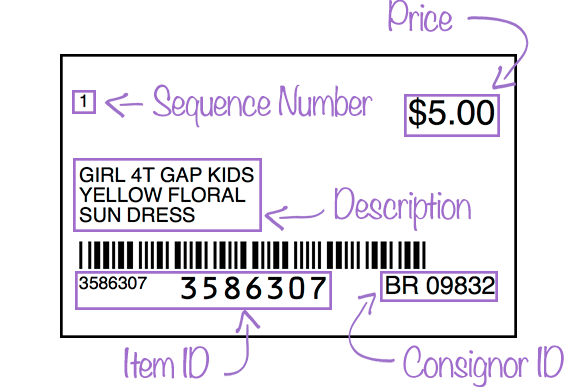
- Sequence number: Each time you print a set of tags, every tag gets a sequence number starting at 1. If you kept your items in order as you entered them, the first tag goes on your first item, and so on, and if you ever play a game of 52-card pickup with your tags, the sequence number helps you sort them back out. 🙂
- Price: The sale price for the item. If you want to change a price, you must change it online and print a new tag. Hand-writing a price change does not change it in our system.
- Description: The description you entered prints here. For space reasons we may not fit every word, so make the first words count.
- Item ID: Every item has a unique item ID, it's how we make sure you get paid when the item sells. Please make sure every item you bring has an item ID.
- Consignor ID: Very important for sorting and making sure your items come back to you at pickup.
- Donate & half price: In this example there is no dot on the tag, so the item can sell at half price. There's also no "D" for donate, so the item will be sorted and returned to the consignor at pickup.
👕 Do I need hangers, and how do I hang clothing?
Yes! Most clothing is sold on hangers, just like a traditional retail store. Consignors provide the hangers, and the hangers stay with the clothing.
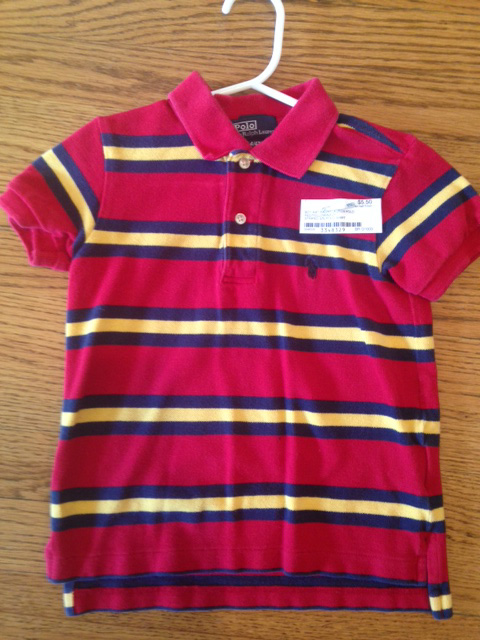
Turn every hanger hook to the left, so the hook looks like a question mark when the garment faces you. Place your barcode tag on the right side of the garment, that puts the tag on the outside of the rack where shoppers can easily see it.
- Use only one hanger for two-piece outfits.
- Hang the shirt first, then turn the hanger over and pin the waist of the pants to the back of the shirt at the shoulder seams.
- Don't pin second pieces (pants or skirts) under jackets or shirts, hidden pieces are less likely to sell.
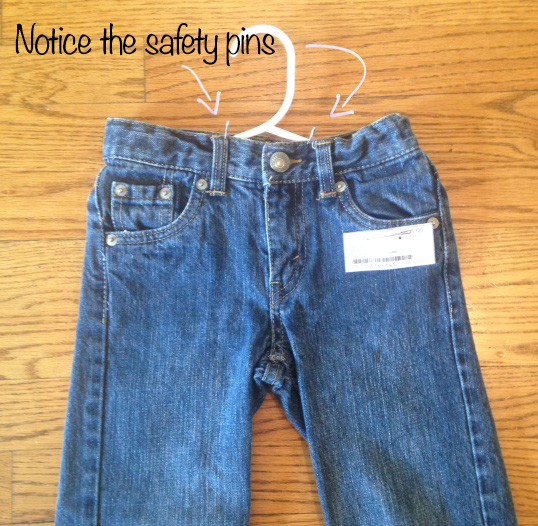
- Pin pants with two safety pins at the waist, one on each side of the hanger's hook. This keeps the pants fully visible and off the floor.
If that sounds confusing, don't worry, here are a couple of visuals to help.
👟 How should I tag my shoes?
Following these steps helps us sell your shoes even if the barcode tag becomes separated:
- Punch a hole in the barcode tag.
- Connect the two shoes, and the tag, together by tying the shoestrings or using ribbon, cable ties, or twist ties.
- Place a piece of masking tape on the bottom of each shoe with the item ID written on it (the number below the barcode). Do not use gummy tape like duct tape! This step is very important.
🧸 How should I tag toys, baby equipment, and décor?
Some items take a bit of creative thinking! In general, we suggest zip ties and/or clear carton tape to affix the tag. If you use carton tape, attach the tag so it won't pull paint off when the buyer removes it. For example: for a toy car, punch a hole in the barcode tag, then use a cable tie to attach it to the steering wheel.